


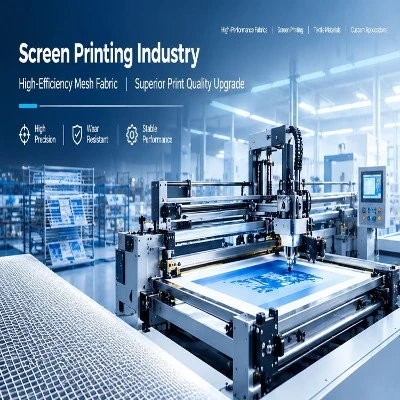
Screen printing comprises five key elements: the screen printing plate, the squeegee, the ink, the printing bed, and the substrate.
The fundamental principle of screen printing relies on the selective permeability of the screen mesh: ink passes through the mesh openings in the image areas but is blocked in the non-image areas. During the printing process, ink is poured onto one end of the screen plate; the squeegee applies pressure to the ink while moving toward the opposite end. As it moves, the squeegee forces the ink through the mesh openings of the image areas onto the substrate. The ink's viscosity ensures the printed image remains within defined boundaries. Throughout the process, the squeegee maintains linear contact with both the screen plate and the substrate, with the contact line shifting as the squeegee moves. A specific gap is maintained between the screen plate and the substrate; consequently, the screen plate's tension generates a counter-force against the squeegee-a force known as "snap-off" or "rebound" force. This force ensures that the screen plate and substrate maintain only a moving line of contact, while the rest of the screen plate remains detached from the substrate. This separation facilitates the clean release of ink from the mesh, ensuring dimensional accuracy and preventing smudging of the substrate. Once the squeegee has traversed the entire image area, it is lifted along with the screen plate, and the ink is gently scraped back to its starting position. This completes a single printing stroke.