

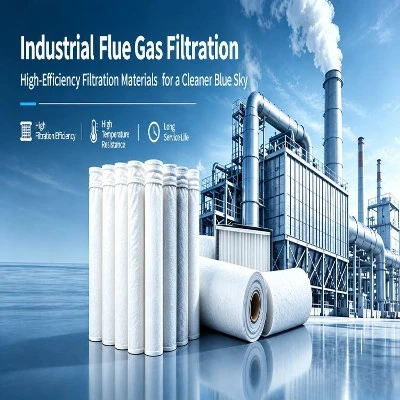

Aramid fiber needle-punched felt-characterized by excellent mechanical properties, chemical stability, and ideal physical performance-is one of the most suitable filter media for high-temperature flue gas filtration.
It demonstrates outstanding overall performance; in addition to high-temperature resistance, it offers superior strength, as well as excellent abrasion and flex resistance. Key specifications include: a basis weight of 450–550 g/m², a thickness of 2.0–2.4 mm, and air permeability of 13–25 m³/(m²·min). Warp-wise breaking strength exceeds 800–1100 N/(5×20 cm), and weft-wise breaking strength exceeds 800–1300 N/(5×20 cm); warp-wise elongation is less than 20%–35%, and weft-wise elongation is less than 40%–55%. The material withstands long-term temperatures of 180–204°C and momentary temperatures of 220–250°C. It also exhibits high dimensional stability, with a thermal shrinkage rate of only about 1% at 230°C. Regarding flame retardancy, it only begins to decompose and carbonize at 400°C, possesses a Limiting Oxygen Index (LOI) of 30, and neither spontaneously ignites nor supports combustion. Furthermore, aramid needle-punched felt offers excellent resistance to chemical corrosion, including resistance to acids and alkalis.
During high-temperature flue gas purification, various gas components can accelerate the aging of the filter medium and shorten its service life. Experimental studies indicate that temperature, exposure time, and the gas environment influence its strength characteristics: in both air and nitrogen atmospheres, as temperature rises and treatment time extends, the aramid undergoes thermal and oxidative cross-linking; consequently, its warp and weft strengths initially increase before decreasing, reaching a maximum value at approximately 220°C.