




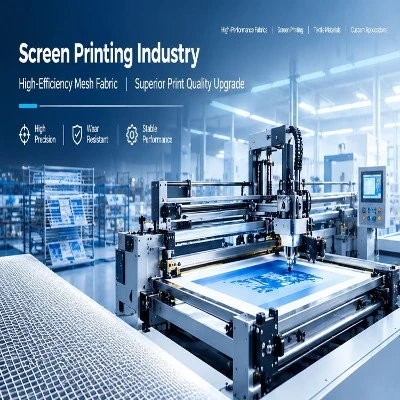
Screen printing generally falls into two categories: Manual printing and mechanical printing.
Manual printing refers to a process where every step-from feeding and collecting the substrate to the vertical movement of the screen and the actual squeegee stroke-is performed by hand.
Mechanical printing refers to a process where the printing actions are carried out by machinery. This category is further divided into semi-automatic and fully automatic printing: semi-automatic printing involves manual loading and unloading of the substrate while the printing itself is done mechanically, whereas fully automatic printing means the entire process is performed by machines.
There is also a quick and simple method for curved-surface screen printing known as "flexible-screen printing" (or "loose-screen printing"). This involves detaching the screen mesh from its frame and pressing it directly against the substrate surface for printing. This method is suitable for printing on a wide range of products, such as plastic buckets, purified water containers, washbasins, thermos flasks, cups, bowls, and plates. It can also be used to print signage on vehicles or text on irregularly shaped flat surfaces.
To create a flexible screen: First, dry and touch up the exposed screen (bearing the text or image), then detach it and trim it to the required size. Secure the two ends of the mesh firmly using adhesive tape over a rigid support-such as a strip of wood or aluminum-or by using adhesive directly; this completes the flexible screen. The operation method is as follows: select and mix the appropriate ink based on the substrate. For items like flat plates or trays, mix the ink, then have one person hold the flexible screen with both hands, pressing the printing area firmly against the substrate. Meanwhile, a second person uses a squeegee to pick up an even amount of ink from the mixing board and then applies it by drawing the squeegee evenly across the screen surface.
If the printed graphic covers a large area, ink may be poured directly onto the screen surface, provided care is taken to prevent it from running off the substrate. Ensure the mixed ink is neither too thin nor too dry; the consistency should be just right. For small-scale printing of text or images, the process can be handled by a single person: simply secure one end of the printing screen to the desired position on the substrate using packaging tape, then use your other hand to pull the screen taut against the substrate to begin printing. When lifting the screen, take care to lift gently in the direction of the taped edge-the same applies if two people are performing the task. This printing method offers ease of operation and flexibility regarding the substrate (accommodating various sizes and quantities) while being cost-effective and energy-efficient.